
One of the most persistent misconceptions in shooting is that a bullet somehow “rises” above its original path after it leaves the barrel.
It doesn't.
Yes, it travels in a parabolic arc on the way to the target.
Yes, if the target is far enough away, the bullet's elevation, as it travels on this arc, is higher than the rifle.
Yes, as the bullet travels "up the arc" it is rising away from the ground before it falls back down into the target.
However, the bullet is falling from its original path the moment it leaves the barrel and nothing causes the bullet to "rise" above it's current path.
How can this all be true?
The Bullet Rising Myth
This misconception (or, perhaps, myth) usually involves the belief that a rifle's barrel is pointed straight at a target (perfectly level if the target is across straight ground) and then as soon as the bullet leaves the barrel from being fired, it somehow rises from that level barrel and path to travel in an arc on the way to the target. Or another variation I've heard (and unfortunately have seen in drawings of people trying to explain this), is that the bullet travels on the straight path from the level barrel for a bit before it rises.
Unfortunately, for reasons I'll explain below, none of this is true.
There are myriad reasons I've heard for why someone might believe this.
First, and a reason for which I can fault nobody, is that they were told this. There's so much in life we believe what we're told that I can completely understand this source. Some people have been told this by their shooting buddy, their father, or worse, someone who was a "sniper" or has military experience and is putting themselves forward as a subject matter expert.
If you fall into this category, you're in a tough spot because I'm going to tell you the opposite and you won't know who to believe. So, later on, I'm going to list my bona fides (which doesn't mean I'm right nor better than anyone but it should hopefully give you some baseline of trust) and I'm going to ask you to note the citations I'm giving below that support my claims.
Second, I've heard various explanations that somehow the fact that the bullet is spinning, due to the rifling in the barrel, makes it rise.
Third, I've heard shooters explain that the barrel is whipping due to harmonics during firing and this whipping action is somehow flicking the bullet up into the air causing it to travel in an arc.
Fourth, some people reference their laser bore-sighter pointing straight at a target aligned with their scope so, if the bullet travels in an arc, it must rise above the bore-axis on its way to the target.
Let's dispel this myth by first explaining what actually happens.
Then, I'll address the three justifications or claims for the myth above.
Why the Bullet Travels in an Arc
Simply, the bullet travels in an arc because the barrel is angled upward and the bore-axis (picture a laser pointer in the center of and through the rifle's barrel) is pointed higher than the target. As the bullet leaves the barrel, it immediately starts to fall away from that bore axis (it never rises above it) and, because gravity is an acceleration, it falls faster and faster away from that bore axis resulting in a parabolic arc pattern to the target.
Now, of course, the barrel may not always be angled upward depending on the target. For example, if you had a perfectly level barrel, the bullet wouldn't arc at all - it would exit the barrel and immediately start falling. This is regardless of how fast the bullet is traveling because, contrary to what some believe, the horizontal speed of a bullet, nor even its mass, have nothing to how fast the bullet falls vertically due to gravity.
Let's break that down into its basic chunks with some citations and proof. After all, this is the foundation of what people who defend the myth above do not believe.
The Barrel is Angled Upward
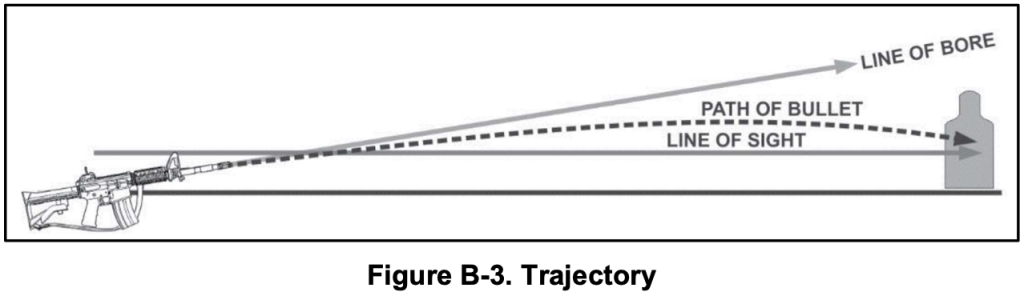
When a rifle is zeroed, the barrel is actually angled slightly upward relative to the line of sight.
I know that this might be hard to believe but it's true. For just three citations from others for this point in addition to, of course, my Long Range Shooting Handbook which explains all of these concepts:
"The firearm's barrel is elevated" - Hornady External Ballistics
"The barrel must be elevated slightly to allow the round to travel farther, creating an arc." - US Army FM 3-22.9 Effects of Wind and Gravity
"To compensate for this effect so that the bullet will impact the target, the muzzle of the rifle must be elevated..." - U.S. Marine Corps, MCRP 3-01A, Rifle Marksmanship
In fact, here's a neat diagram from the US Army Manual that shows the barrel being angled upward, the original line of departure being angled upward, and the bullet dropping away from that bore-axis:
The Bullet Immediately Starts to Fall
The moment a bullet leaves the barrel, it starts to fall off of its original path.
This is true even if the bullet is moving upward because it's original path would have been pointing even higher and the falling away from that path is what makes the arc.
“The trajectory immediately begins to drop below the bore axis.” - Hornady External Ballistics
“When a projectile exits the barrel, gravity immediately takes effect, causing the bullet to drop from the line of departure, otherwise known as the line of bore.” - US Army FM 3-22.9 Effects of Wind and Gravity
“As the bullet exits the muzzle, it immediately starts to fall because of gravity.” and "Earth's gravity pulls the bullet down toward the ground as soon as the bullet leaves the rifle's barrel.” - U.S. Marine Corps, MCRP 3-01A, Rifle Marksmanship
Bullets Fall Regardless of their Speed
The speed of the bullet does not somehow resist gravity due to inertia. In fact, the reason a faster bullet is often called a "flatter bullet" meaning it's arc is flatter and it doesn't require as much elevation in order to hit a target at a certain distance, is because it doesn't have as much time to fall as a slower bullet. It is not because the faster bullet resists gravity's pull In fact, if a faster bullet and a slower bullet were both given the same amount of flight time (a farther target for the faster bullet), then they'd both drop the same amount.
A great example of the horizontal speed being irrelevant to the vertical drop is this experiment: If a bullet was fired from a perfectly level barrel and another bullet was dropped from the same height at the same time, they would both impact the ground simultaneously.
Here's a write-up of an experiment from the ASU physic's department: https://pirt.asu.edu/demos/1D60.20 and here is their video showcasing the proof:
And, here's a video of the Mythbusters team testing this theory and determining that it's true:
Three Different Lines Cause Most of the Confusion
To understand bullet trajectory, you need to distinguish between three things:
- Line of bore / line of departure
- Line of sight
- The bullet's actual trajectory
Confusing these reference lines is the source of most arguments about whether bullets “rise.”
Line of Bore / Line of Departure
Imagine extending an infinitely long, perfectly straight line through the center of the barrel.
That represents the direction in which the bullet is launched.
The U.S. Army defines the line of departure as:
“an imaginary straight line extending from the center of the barrel to infinity.”[1]
Another Army training publication describes it as the path the projectile would follow if there were no gravity and its velocity remained unchanged.[7]
If gravity and aerodynamic effects did not exist, the bullet would continue along that straight path.
But gravity does exist.
Consequently, the bullet begins falling below that imaginary straight line immediately after leaving the muzzle.
The Army is particularly explicit about this:
“When a projectile exits the barrel, gravity immediately takes effect, causing the bullet to drop from the line of departure...”[1]
Hornady describes the same relationship, explaining that gravity and air resistance act so quickly that the line of departure is tangent to the trajectory only at the muzzle and that the trajectory immediately begins to drop below the bore axis.[3]
That's the key concept.
The bullet does not travel along the bore line for some distance before gravity “takes over.”
Gravity starts changing its trajectory immediately down from its original path.
Line of Sight
The line of sight is something different.
The Army defines it as an imaginary straight line extending from the shooter's eye through the sights or optic to the target.[1]
Because a rifle's sights or optic are mounted above the barrel, the line of sight and line of bore are physically separated.
And when a rifle is zeroed, those two lines are normally not parallel.
The barrel is pointed slightly upward relative to the line of sight.
That relationship is what creates the familiar ballistic chart showing a bullet “rising.”
The Bullet's Trajectory
The trajectory is the bullet's actual path through space.
Unlike the line of sight and line of bore, the trajectory is curved.
The Army defines ballistic trajectory as the path of a projectile under the influence of external forces such as gravity and atmospheric friction.[8]
The Marine Corps likewise explains:
“In flight, a bullet does not follow a straight line, but travels in a curve or arc, called trajectory.”[2]
The Marine Corps also states:
“As the bullet exits the muzzle, it immediately starts to fall because of gravity.”[2]
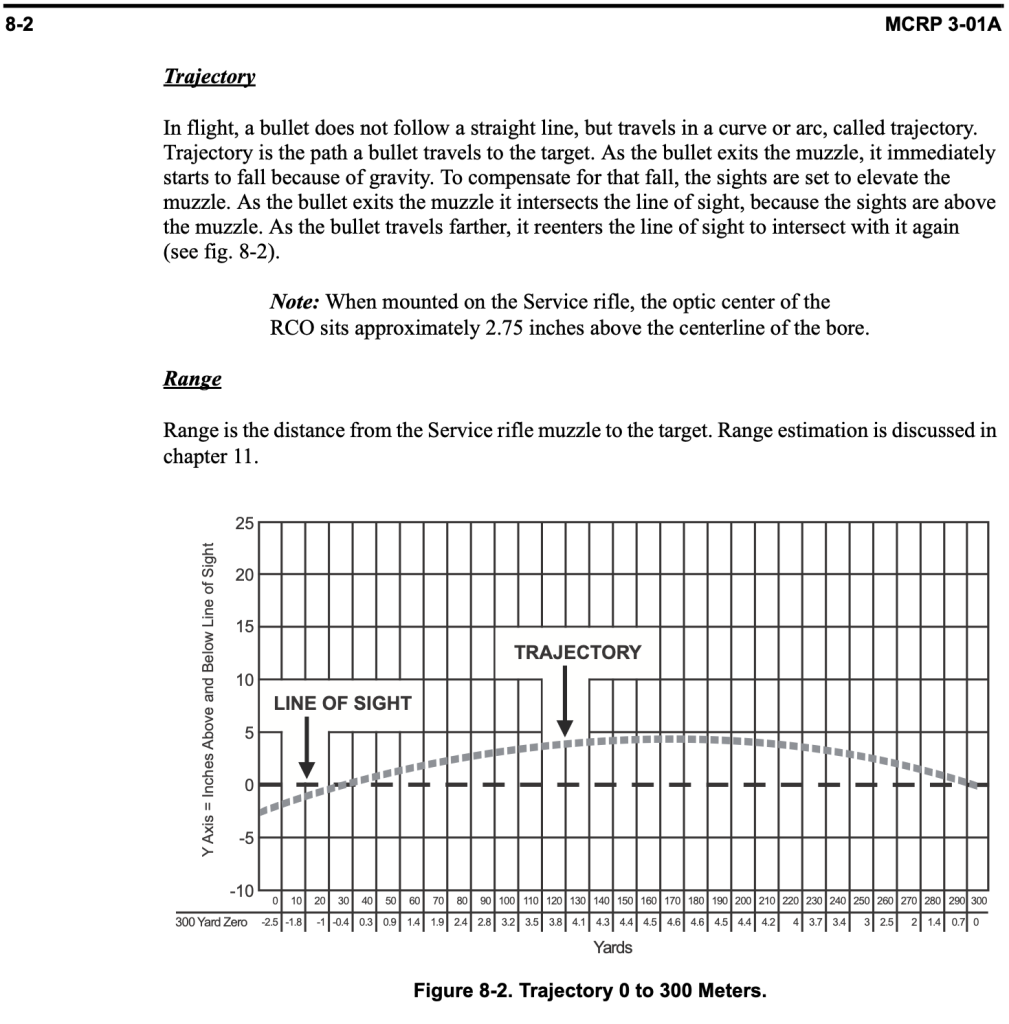
So we now have the Army, Marine Corps, Hornady, and basic university-level projectile physics all describing the same phenomenon.[1][2][3][4]
So Why Does a Bullet Appear to "Rise"?
Because shooters normally measure the bullet's position relative to the line of sight, rather than the line of bore.
Imagine the relationship greatly exaggerated:
The barrel is pointed slightly upward relative to the line of sight.
Therefore, the bullet leaves the muzzle already traveling upward relative to that line of sight.
It can cross the line of sight, continue above it, reach a maximum height relative to the line of sight, and eventually cross the line of sight again at the rifle's zero distance.
The Army specifically describes zero range as the location where the projectile intersects the line of sight and notes that this can occur twice—once while the bullet is traveling upward relative to the sight line and again while traveling downward relative to it.[1]
The Army also defines the bullet's maximum ordinate as its maximum height above the line of sight.[8]
Notice the reference:
Above the line of sight.
Not above the line of bore.
That's the distinction.
Nothing causes a bullet to turn upward after leaving the barrel.
It was already traveling upward because that's where the barrel was pointing and it didn't rise as it left the barrel, it immediately started to fall.
Gravity was pulling it away from that initial path from the moment it exited the muzzle.
A Simple Thought Experiment
Imagine a perfectly level barrel positioned high above an enormous flat surface.
Now fire a bullet perfectly horizontally.
What happens?
The bullet doesn't travel straight for some distance and then begin dropping.
It starts falling immediately.
Ignoring air resistance, if its initial vertical velocity is zero, its vertical displacement is:
y = ½gt²
The faster the bullet travels horizontally, the farther downrange it gets during a given amount of time.
But its horizontal velocity does not give it immunity from gravity.[4][5][9]. In other words, it does not matter how fast it is moving down-range, all bullets fall at the same rate.
Arizona State University's projectile-motion demonstration illustrates this nicely: one ball is simply dropped while another is launched horizontally at the same instant. Both fall at the same rate and reach the ground simultaneously because horizontal velocity does not change gravitational acceleration.[9]
This is the classic independence of horizontal and vertical motion.
Georgia Tech's physics materials describe the same principle: the horizontal and vertical components of projectile motion are independent, with gravity continually producing the vertical acceleration.[6][10]
Speed Doesn't Make Gravity Wait
There's no mechanism that allows a bullet to leave a horizontal barrel, continue straight for some distance, and then spontaneously begin falling.
Gravity doesn't wait.
Near Earth's surface, gravitational acceleration is approximately:
9.8 m/s², or about 32.2 ft/s² downward.[4][6]
That acceleration exists from the beginning of the projectile's free flight.
If a bullet leaves a perfectly horizontal barrel, its initial vertical velocity is zero.
Immediately afterward, its vertical velocity is downward.
It has therefore fallen below the straight-line extension of the bore.
The Army's current rifle and carbine training material makes essentially the same point, describing gravity as acting on the projectile at approximately 9.8 meters per second squared and causing the projectile to drop from the line of departure.[8]
But Doesn't the Bullet Actually Go Up?
Yes.
And this is where we need to be precise with language.
If I point a rifle upward at 30 degrees and fire it, the bullet obviously travels upward.
But it travels upward because the barrel launched it upward.
The bullet does not leave the barrel traveling along one path and then generate some force that causes it to rise.
A projectile launched upward has an initial upward component of velocity. Gravity immediately begins reducing that upward velocity.[4][5]
Eventually, the vertical component of velocity reaches zero at the apex. After that, the projectile moves downward.
But throughout the entire flight, gravity has caused the projectile to be lower than it would have been if gravity didn't exist.
The same principle applies to the much smaller launch angle of a rifle zeroed at 100, 200, or several hundred yards.
The scale changes.
The physics doesn't.
“Rise” Relative to What?
This may be the easiest way to settle the entire argument.
Whenever someone says:
“The bullet rises.”
Ask:
“Relative to what?”
Relative to the ground?
It certainly can. After all, a shot across flat ground and target at distance will result in the bullet traveling in an arc.
Relative to the shooter's line of sight?
Very commonly, especially at further distances.
Relative to the straight-line path established by the bore at the instant the bullet exits?
No.
From the instant the bullet is free of the barrel, gravity accelerates it downward from that path.[1][2][3][4]. It starts to fall, it does not rise.
This distinction between reference frames is important in physics generally. A projectile's position, velocity, and displacement must always be understood relative to a specified coordinate system or reference frame.[4][11]
In shooting, saying that a bullet is “high” or “rising” without identifying the reference line is therefore incomplete.
What About Spin, Aerodynamics, and Lift?
Real bullets are more complicated than the idealized projectiles used in introductory physics.
A real rifle bullet experiences aerodynamic drag. Its spin also introduces additional effects. Depending on the circumstances, exterior-ballistic calculations can account for yaw, precession, nutation, spin drift, aerodynamic jump, Coriolis effects, atmospheric conditions, and other variables.
Those effects matter when we're doing precise external ballistics.
But none of them provides the ordinary explanation for the familiar “bullet rise” shown on a zeroing diagram.
That apparent rise primarily exists because the barrel is pointed upward and the bullet leaves at an upward angle and starts to drop further and further away from that initial trajectory resulting in an arc.
Hornady's exterior-ballistics explanation illustrates exactly this relationship: the barrel is elevated relative to the baseline/line of sight, while the trajectory immediately curves below the line of departure because of gravity.[3]
The Army and Marine Corps describe the same geometry.[1][2][8]
The Simplest Way to Say It
A bullet doesn't leave the barrel, fly straight, and then rise.
It leaves the barrel traveling in the direction the barrel pointed it.
From the instant it exits, gravity begins accelerating it downward from that original path.
If the barrel is pointed upward, the bullet can continue traveling upward for some distance while gravity is simultaneously causing it to fall away from the straight-line path it would have followed without gravity.
And because a zeroed rifle's barrel is typically pointed slightly upward relative to its line of sight, the bullet may cross the line of sight and appear on a ballistic chart to “rise” above it.
So both of these statements can simultaneously be true:
The bullet is traveling upward.
The bullet is falling.
The apparent contradiction disappears once you identify what you're measuring the bullet against.
Sources and References
[1] U.S. Department of the Army, FM 3-22.9, Rifle Marksmanship, M16-/M4-Series Weapons, Chapter 5, “Trajectory,” paras. 5-102–5-107. The manual states that gravity “immediately takes effect” when the projectile exits the barrel and defines line of sight, line of departure, zero range, apex, and bullet path.
[2] U.S. Marine Corps, MCRP 3-01A, Rifle Marksmanship, Chapter 8, “Trajectory.” The Marine Corps explains that a bullet follows a curved trajectory and “immediately starts to fall because of gravity” upon leaving the muzzle.
[3] Hornady Manufacturing, “External Ballistics.” Hornady explains line of departure, bore elevation, gravity, drag, and bullet trajectory, specifically noting that the trajectory immediately drops below the bore axis.
[4] OpenStx, University Physics Volume 1, §4.3, “Projectile Motion.” University-level treatment of projectile motion, including independence of horizontal and vertical motion, gravitational acceleration, trajectory equations, and upward-launched projectiles.
[5] OpenStax, College Physics 2e, §3.4, “Projectile Motion.” Explanation of acceleration due to gravity, maximum height, trajectory, and independence of horizontal and vertical motion.
[6] Georgia Institute of Technology, Physics Book, “Projectile Motion.” Describes the constant downward gravitational force on a projectile and mathematical independence of horizontal and vertical components.
[7] U.S. Army training manual, Appendix B, External Ballistics/Parts of Trajectory. Defines line of departure as the path the projectile would follow without gravity and defines bullet drop as the distance below that line.
[8] U.S. Department of the Army, TC 3-22.9, Rifle and Carbine, Appendix B, “Ballistics.” Defines external ballistics, line of bore, line of sight, ballistic trajectory, maximum ordinate, gravity, drag, and other external-ballistic terminology.
[9] Arizona State University, Physics Instructional Resource Team, “Simultaneous Fall.” Demonstrates that a horizontally launched object and an object simply dropped from the same height experience the same downward gravitational acceleration.
[10] Georgia Institute of Technology, Physics 2211, Lab 6: “Projectile Motion.” Explains that horizontal and vertical projectile motion are independent and linked by time, with vertical acceleration due to gravity.
[11] OpenStax, University Physics Volume 1, Chapter 4 Key Terms. Defines reference frame, projectile motion, trajectory, velocity vector, and related terminology.
My name is Ryan Cleckner and I am a former special operations sniper from the US Army's 1st Ranger Bn and I am a graduate of SOTIC, now the Special Forces Sniper Course (SFSC), which is widely regarded as the premier military sniper course in the world. I am the best-selling author of the Long Range Shooting Handbook (over 250,000 copies sold and a #1 bestseller on Amazon for 10 years straight) and Advanced Long Range Shooting. I have taught as a sniper instructor for military and police units across the globe and have many instructional videos on long range shooting with millions of views each for the NSSF, Warrior Poet Society Network, and others.